Sunday, 15 March 2015

Jupiter Ascending


We very nearly missed Jupiter Ascending, just barely catching her last gasp in UK cinemas. We were so oddly committed to seeing the film we actually trekked to a 10.40am – yes, 10.40am – showing, at a Cineworld buried deep in the bowels of Shopping City, Wood Green. I’m glad I didn’t miss the movie. I enjoyed it.

I’m not entirely sure where the really bad notices are coming from. I could never award one or two stars to a film purely on the basis of it being daft. Jupiter Ascending is plenty stupid, but it entertains far better than, say, Prometheus (which bored me silly) and it never made my teeth grind like Pacific Rim (which I had to switch off after five minutes and will never attempt again).

All of these B movies suffer from being made in our Age Of The Bloater (Prometheus is 124 minutes, Jupiter is 127, Pacific Rim 132). But Jupiter is so light hearted that it only lost me for twenty minutes or so, during the space wedding sequence. Otherwise I was right there with it.

Anyway, a few thoughts:

Oop - there she goes again
Jupiter Descending

Jupiter does spend an awful lot of time tumbling from a great height, only to be scooped up by Wolf Boots, or whatever his name is. She is rather kicked around by events – which wouldn’t matter so much if she had better lines. Kunis has a long association with comedy (albeit Family Guy’s nasty stuff) and I’m surprised the Wachowskis didn’t tilt the part in that direction after casting her - Jupiter has one or two moments that cry out for a zinger that never comes. Kunis isn’t great, but better anyone than the originally mooted Natalie Portman, who should steer well clear of this stuff.

Jupiter Viewing

Well, let Jupiter drop, fall, plunge and plummet to her heart’s content – so long as I can see what the hell is going on. It’s not perfect, but the film does manage to occasionally show the audience what is happening - and that has been rare in the Bloater age. The skies are never overcrowded in the aerial battles, and the combat in general is never overwhelmed by machine gun cuts and too close close-ups. All of the action sequences are enjoyable for their willingness to step back and let you see.

Give over, there's nowt wrong with your ears
Jupiter Strutting

To do that requires confidence, and the Wachowskis have it in spades. The movie has a cocksure stride and humming energy that endeared me to it instantly. I like a film that knows it place and can tell what’s important: so while it pauses a moment to mock the idea that we are alone in the universe, it doesn’t bother to ask Sean Bean to try a different accent. I can imagine how this quality might wind up some viewers: Jupiter’s convenient leaps in understanding (she memorises interstellar law in a jiffy) might seem like carelessness. But to me they indicate the Wachowskis urging the story on, not stopping to try and Polyfilla cracks along the way. Start picking at them and you’ll realise how structurally unsound the whole thing is. Anyway who cares? The bees are fighting the aliens! 


Jupiter Looking

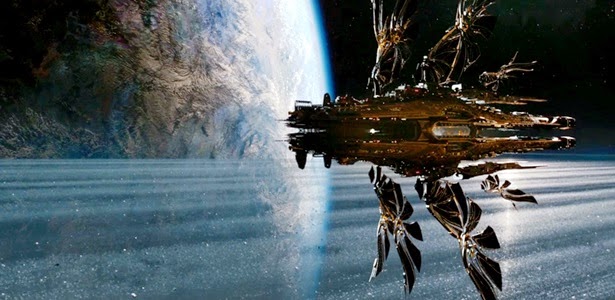
The visual experience is a strange cocktail of the ludicrous and the accomplished. The outfits in this movie have drawn Flash Gordon comparisons, and that’s appropriate: one particular shreddy-skirted number Kunis sports is at least as funny as Max Von Sydow’s pointy beard. Yet even as I hooted and slapped my thigh, a shot of the Great Red Spot would appear, churning on Jupiter’s surface, and I would be impressed. The aliens are decent too - it seems to me a lot of care was taken to give the two main species convincing gait and movement. OK, so the film doesn’t let you think too much of it, jolting you with more of Channing topless, of Redmayne in a neck bracelet. But what the hell- I can gasp and chuckle too, can’t I?

Jupiter Speaking

Among the explosions of glitter the film finds a little space to talk about class. Jupiter’s character isn’t the best means of delivering the message – what her part says on the subject is something of a muddle - but the idea of a creepy, hidden caste of aristocrats, drooling over the Earth as if it were one giant stock, is one that resonates. OK, so the script doesn’t ever bite on the subject, but Redmayne and his siblings are there, squabbling over humanity like a jar of Nutella - and their very presence is clearly there to show us the shadow of a looming Feudal system. For a movie in which a David Bowie cameo would have come as no surprise at all, that is something of an achievement.


Friday, 27 February 2015

A few thoughts on Leonard Nimoy


I’ve been meaning to write a new Star Trek blog for some time now. Tonight I have finally run out of excuses. For tonight is the night of Leonard Nimoy’s death. I will soon post about Star Trek (TOS) Season Two, but until then I must present a few words on a wonderful, underrated performer with a classy sense of humour.

The fact is that Leonard Nimoy played a crucial role in my development both as a viewer - because he kept surprising me - and as a writer, because he helped show me the great depth science fiction stories can have.

My first encounters weren’t encouraging. I think the first Trek movie I saw in the cinema was Star Trek 5 (which is an awful snooze no matter how you slice it) and shortly after I discovered his Bilbo Baggins music video. Neither created the impression of someone to be taken seriously. It was easy to dismiss him as little more than a vessel for those ears, the lucky bearer of an iconic part anyone could have played.

But he kept cropping up during those teenage years, that period of life when your taste really crystalises, and he kept startling me - offering excellent performances in places I didn’t expect to find them. He was such a revelation in Wrath of Khan (more of that later) that my friends and I sought out his other work. So it was we discovered Invasion of The Body Snatchers, a beautifully bleak science fiction remake, shaped around Donald Sutherland’s lead and Leonard’s cool, unflappable Doctor David Kibner.

Then there was TV. I had a deep affection for 70s Colombo during my late teens and early twenties, appreciating this most formulaic of formulaic shows mostly for its brilliant cars, clothes and reassuringly familiar devices. Occasionally there was an episode that did something a little special - usually marked by an outstanding performance. Leonard Nimoy guest starred in one such show, delivering a stony portrayal of a killer so calculating he actually causes Colombo to lose his cool - a rare occurrence of the detective breaking out of character.

Then there was Leonard’s Simpsons work. He was one of the first celebrities to have the self-confidence to send himself up in the show, and remains one of the very few cameos to be funny in his own right. Where others draw laughs as objects for Homer’s scorn/lust/admiration, Leonard makes his own funnies – check out his introduction to the X-Files episode. Of course this is largely due to the writers, who worship the man like a God, but the fact remains that when I saw his episodes at school I was hugely impressed by his wit, and by his class.

So Leonard helped make me more tolerant and inquisitive as a viewer. More importantly, Leonard taught me that science fiction could be truly moving.

Wrath of Kahn was a major event in my movie history. The film delighted me, providing everything I had always wanted from space opera - humour, spaceships (fighting each other) and at least a nod to the sublime – but added a startling extra: a genuinely moving, human scene, hinging on a broken yet dignified performance by Nimoy.

It might sound daft, but it was a moment that really spoke to me. It was one of the first occasions that I found science fiction touching. Alongside three or four other early experiences, it bred an ambition to write something even half as accomplished.

I’m ashamed to say that I’m only beginning to discover Star Trek The Original Series now, which is the very definition of doing it backwards – but, as always with Leonard, the experience has been a revelation. He may be gone, but I’m still getting to know him.


Sunday, 15 February 2015

New website!


For a while now I've been meaning to create a new website to compliment thingaboutchickens.

When I started out blogging I was producing opinion pieces and the like, interspersed with links to my short stories as they were published. I was fairly clueless about it, approaching blogging like a kind of online scrapbook.

I began to add movie reviews, and bits and pieces on science fiction TV and literature. Then Barricade came along, and I added updates about that. The whole thing began to feel like a bit of a mess  - and besides, it was always daft having a website without my name in the title.

So it is that I've created a new site, jonwallace.co, purely for posts relating to my writing (featuring the above posh snap by the one and only Jack Ladenburg). It's taken me an age to actually get my rear in gear about this, and despite the techno fear/ rage that was involved in its production (I am sub Cro-Magnon when it comes to this stuff), I am well pleased to have the site sorted out. I'll update soon with articles covering everything from my new book's cover art to the love of dogs. There'll also be regular updates about the forthcoming sequel to Barricade (Steeple, coming in June), related articles and hopefully details of new short stories (I have to write some of these freaking ideas and send them off!)

I certainly don't intend to let thingaboutchickens fade away - in fact I am going to try and post here more than ever. I've had some great interest in past opinion pieces (like those on Macca and Cardinal O'Brien) and have the need to scratch this commentary itch regularly. I also can't help but write about TV and film - so look out for forthcoming pieces right here on Star Trek The Original Series (Season Two), and the madness of nuclear weapons.

In the meantime many thanks to all the brilliant folk who visit thingaboutchickens. Please do keep up your visits, and comment if you care to - I'd love to hear from you.


Wednesday, 28 January 2015

Parliament Square has all the charm of an over-policed roundabout.


I recently ceased working in the Parliament Square area, and I’m quite happy about it. Over six months I developed a quite powerful dislike for the place.

I'm not moaning about the tourists– if anything I feel sorry for those visitors to our capital who include Parliament on a tour. If I emerged from the Underground I would take one look around me, tick it off the sightseeing list, and depart immediately. Why? Because the square is hostile, ramshackle and utterly fails to deliver, on whatever level you approach it.

You want antique Imperial bombast? Sorry, it's hard to pick that up when Parliament and Westminster Abbey sit on a perpetually clogged roundabout, bathed in the roar of diesel engines and the tetchy blare of horns. I suppose the statues scattering the central island might hit your 'I' spot, but you’ll only get a decent look if you can figure out how to traverse the confusion of traffic – and good luck with that.

You want a modern, transparent seat of power? You’re bang out of luck. In terms of a public space this is a distinctly unfriendly one. The Palace of Westminster sits behind hideous knee-high black barriers, tossed into the road after 9/11 and left to become a permanent disfigurement. Parliament Square, meanwhile, lives half its life hidden behind a mess of grilled, grey, security fencing.

Traffic, fences, backs of statues. 
It doesn't make anyone safer, this fencing - it's just there to emphasise the square's defining message to any visitor foolish enough to arrive without an appointment. Namely: ‘get lost, pleb.’ This message is of course, particularly aimed at those who come bearing placards.

Westminster's overreaction to any form of protest is quite astonishing when you see it on a day-to-day basis. One small gathering I witnessed saw police outnumber protesters by something like four to one. The plods roll in at the merest hint of organised assembly, tossing up barriers and sitting packed in transit vans along Whitehall, seeming to say: 'go on, just try it'.

All this hardly helps change our image of Westminster politicians as cowardly and out of touch. It only reinforces the perception that they'd  prefer to lock the square up behind railings, like a private Belgravia garden – or, better yet, erect a concrete wall around the entire area, complete with battlements, taser-packing guards and drawbridge (to allow the orderly egress of despot limo and party caterer).

The point is, what do we want from the home of our Government? A fortress or a public space? It is neither at the moment. It's a knackered Victorian folly, ringed by exhaust and coppers packing heat.

So I have an idea: an elegant solution that will help MPs hide more efficiently from their voters, and free up a striking bit of Thames-side real estate for tourists and Londoners alike. The idea? Move Parliament.

There’s plenty of precedent for them sitting elsewhere, and the Palace is horribly unsuited as a place of business anyhow (and in dire need of refurbishment). It would serve far better as a tourist attraction, overlooking a pedestrianized square with trees, grass, and maybe a comfy bench or two.

Parliament, meanwhile, could move into The Excel Centre. I can’t see many people objecting to that bleak box being fenced off, or many protest marches making it their finish line – arriving at Custom House could only be something of an anti-climax. Most importantly, the building is just forbidding, charmless and dull enough to reflect mainstream politics.

And if MPs get too depressed based out there (and believe me, they might) they can always ask to come back home – and we should let them. But only if they accept that it’s our Square too, and leave those bloody fences out East.

Monday, 5 January 2015

Dark Star (1974)


A few words on Dark Star, which I saw for the first time just before Christmas. I've been meaning to watch it for about a decade now, but somehow never got around to it. I knew it was a stretched John Carpenter student film, and it's regularly mentioned in lists of 'greatest ever science fiction movies', yet I could never build momentum for a viewing. How daft that seems now.

Written by John Carpenter and Dan O'Bannon, and unfolding over a super-tight one hour and twenty-two minutes, I watched it with a building sense of awe. The opening scenes were so strong that I assumed the rest of the film couldn't possibly live up to them. Then the titles kicked in, with the splendid country song Benson, Arizona (music by Carpenter) and the movie just went on delivering.

Charting the bickering, bearded crew of Dark Star on their journey of meaningless destruction, the film is characterised by surprisingly sharp wit, unique lo-fi space effects, and a deep love for its characters.

I won't get into it too much, in case there are other idiots like me who have never seen it - I wouldn't want to spoil it for you. Suffice to say that I found it a humbling and delightful experience. Almost every element made me smile, from Cookie Knapp’s superb computer voice to the emergency phenomenology.

God it’s imaginative and clever and bravely paced and well acted and surprising. It has been a long time since something impressed me so much - what a talent Carpenter was. It's free to stream on Amazon, so if you haven't seen it, take a look. You won't be disappointed.

Friday, 12 December 2014

Interstellar

Splitty wardrobe robot to the rescue

Interstellar very nearly passed me by. I found the trailer a little dry, and wasn’t that attracted by the cast. Still, I found myself ejected from the office at 4PM on a Thursday, and having nothing better to do I thought I would check it out before it disappeared from screens.

I saw it at the Waterloo IMAX – which I have been meaning to visit since they were building the thing – and had a pleasing experience. Prior to the show a cinema official stepped out front with a microphone to boast about his whopping screen. It’s the largest in Britain he said, and though we were watching a digital projection instead of film, we should be assured his digital team was among the best in the world. I liked them taking pride in their kit – it helped create a sense of occasion.

Anyway, some thoughts:

Waste

For a starving world, Interstellar’s United States is a very calm place. Its people are quietly dignified, indomitable farmers, fleeing a future dustbowl in SUV jalopies. Their plight is briefly noted but not investigated, as this film isn’t here to talk about the perils future Oakies might face on their travels across the blighted Earth – whether prejudice, starvation, or violence. Hints are made about the country having emerged from a period of conflict, but you see little trace of that.

The film whispers something about the wasteful old materialistic society that created the new wasteland, and wants to condemn its profligacy - yet propagates tossing away an entire planet as the solution. There is also no discussion of how man will treat its new home planet once established. It would have been nice if someone suggested that, in leaving Earth, we might want also want to leave behind the rampant capitalism that caused all this… but I guess that would be too un-American.

America

The film’s experience is wholly American, and that is a little strange for a film about humankind taking an evolutionary step. The existence of other nations is only acknowledged when Cooper chases an Indian Air Force drone through a cornfield. That whole sequence reeks of an America that feels reduced, or slighted:  a world in which India can spy on the US is a world gone mad, and one that must be left behind.

But really, are we going to beat up Nolan for producing an entirely American fantasy? In some ways it’s a good thing – at least there is no drunken cosmonaut comedy relief, or token references to destroyed foreign nations. And what’s wrong with suggesting that a reawakening of the pioneer spirit might be a good direction for American ambition, now that the superpower thing is ebbing away?

Change

Trouble is, pioneers tend to impose themselves on new worlds, as opposed to integrate. And so it is with Interstellar: here the plan for man’s great leap forward seems to be: transplant America to a place where people can’t hurt it, then reset and carry on playing baseball.

The colonisation of space doesn’t really change man – the film loves relativity and has fun with it, but can’t escape the pull of the (very familiar) father/daughter reconciliation story at its core –so it doesn’t get to explore any of the outer reaches that you find in great science fiction literature.

I could moan about all the wonderful books there are out there which have far more interesting things to say– but a part of me knows that Hollywood simply can’t work with those kind of materials. If Universal tried to make Revelation Space they’d almost certainly bugger it up - probably by dumbly tacking on a 'relatable' father daughter narrative. This at least is built on a Hollywood premise, and feels solid enough as a result.

Down to Earth:

In the end, I have to admit that all these thoughts came to me after watching the film – seated in the cinema I was with Interstellar, heart and soul. Despite all the questions, or maybe because of them, it’s an excellent production.

The design is superb. I am a particular fan of the splitting wardrobe robots, and each world is brilliantly realised. The action sequences are astonishing – the 'crazy Damon' hatch blow-out, and subsequent spinning dock sequence, drops the jaw.

Overall it is the best Nolan could have produced within the constraints of what seems like an increasingly conservative studio system. If it gets a few of us looking up from our phones to the stars, that can only be a good thing.

And if it does leave me with an itch, a sense that there are better stories in science fiction literature, why moan? Better to go to the bookshelves, select some likely looking treats, and accept that there are some things Hollywood won’t ever do as well as the written word.


Saturday, 27 September 2014

Barricade in August: #nineworlds #gollanczfest, #loncon3 and all...

Caption competition!

Now that my holidays are done I thought I’d document a few thoughts about the conventions that packed out my August - one particular ten day stretch involved Nineworlds, Fantasy in the Court, Gollanczfest, and Worldcon. It was exhausting and tremendous fun in equal measure, and I wanted to get a few thoughts down about it before it fades from memory.

Love the total strangers

I’m easily intimidated by large crowds and remain a shocking networker, so I approached the conventions with some trepidation. However, I’m glad to report that I did fine - simply by settling my nerves with an early pint, mooching about and letting the event bump into me. I had some brilliant conversations with complete strangers, on subjects as varied as the ugliness of Athens to the merits of safari jackets.

Curiously the spirit of the genre seemed to travel with me, out of the conventions and into the city. I departed Nineworlds early one evening to attend a leaving do at H’s office. I was reluctant to go, but ended up having a very stimulating exchange with a stranger at the party. It turned out she was a massive Asimov fan, and she told me all about the Black Widower stories, which I had never heard of before.

On another late-night tube journey I was accosted by a fashionable group of 20 somethings, fresh from some club or other. They were seeking nothing more than a friendly chat and, being pleasantly juiced, I was happy to oblige. I soon discovered that one of them was working on Star Wars Episode VII - I had a fascinating talk with him about the production. If I could remember any of it I’d tell you.

Watch rocket scientists

I missed out on a lot of Worldcon panels due to overcrowding, but I really enjoyed the BIS (British Interplanetary Society) events I attended. It’s refreshing to hear a succession of brainiacs spell out how very doable expansion into space actually is, even if the species remains depressingly noncommittal. On the other hand, there is a dark side to these speakers.

One in particular caught my attention. He was advocating human expansion into the asteroid belt, and he’d come packing statistics: 380 trillion terrawatts of energy produced by the Sun, 1000 years of extraterrestrial travel made possible by harnessing that energy, the asteroid belt’s potential to house 100 times the Earth’s population. These were seductive, awe-inspiring numbers.

But then I wondered: did he have any figures which predicted how many people might perish in the construction of his asteroid belt utopia? I don’t believe he’d care if he had. To him all that mattered was the space faring society his numbers made possible. All other considerations, particularly environmentalism, were condemned as small-minded horseshit. I think he would happily obliterate the Earth personally if it meant hurrying humanity into space. It was fascinating and kind of funny listening to him, but a little chilling too.

Pity the death weasel

So I’ll come out and say it: I kind of hate the Excel Centre. I’m not having a go at Worldcon organisers, they had to choose from what I imagine is a limited and super-pricey list of London venues. But I have always found the place enervating. I first went there to watch Olympic table tennis and everything about that charmless box made me want to escape.

Panels often took place in hot, packed, windowless rooms. I had my first moderation job in one of the smaller spaces, and it got off to a shaky start when our flustered sound guy announced: “only one of the mics works. You’ll have to move it up and down,” then buggered off at speed before we could protest. We might have been OK, but the moment we started speaking a persistent, incredibly irritating noise filled the room. I can only describe it as like someone sawing a weasel in half. It drove audience and panel to distraction - until we figured out we could stop it by switching off our mics. We had to yell our way through the rest of the event.

Aggravating this stifling atmosphere are a lot of overpriced, soulless food outlets, and the location - which is somewhere around the arse-end of nowhere – so there’s no local area to adjourn for half an hour.

Don’t get me wrong, I had a great time at Worldcon and I was privileged to moderate my SciFi comics panel with Scott Edelman, Phil Foglio and others. I’ll also bet that every venue has its bad points - but those Excel mic weasels can really try your patience.

Know your fellow debuts 

One of the pleasures of Crazy August was the opportunity to meet Anna and John, the two US debuts published by Gollancz this year. They were two more impressive, friendly people to add to Ed Cox and Den Patrick and it was a great opportunity to build on our excellent “Class of 2014” camaraderie.

Gollancz did an excellent job of bringing debuts together at panels and events. Meeting them provided me with some useful perspective on my experience (Holy shit, Anna is 17? I couldn’t tie my shoelaces at 17!) and has given me a group of Fantasy authors to introduce me to the genre (being almost solely a scifi reader until this year).

I have only read Den’s novel (the Boy with The Procelain Blade) so far, while H has read the Seventh Miss Hatfield, but we’ll get through the lot soon. You should too. More details here.

Share it all with your love

I wouldn’t have got through the many parties, and all the associated drinking, without the balance and joyful presence of H. People love her. One Gollancz debut approached me one night specifically to tell me that: “Dude, your wife is an absolute fucking delight”. And so she is.

It makes these things so much more fun when she’s there to share in the experience. Being published for the first time feels unique, with all the good and the bad, and it’s been a heady delight to have H by my side throughout.

She has thrown herself into the deep end of SFF, ploughing through genre novels, tweeting the good and the great for all she’s worth and attending what events she can. That kind of support is worth its weight in gold, and it would have been much tougher without it.